Monday, June 20, 2016

In a seller’s market, success favors the focused, prepared buyer


This year, home shopping may feel like hitting a hill at the end of a marathon with a pack of runners closing in on you from behind.
Scraping together a downpayment and winning mortgage approval are just the first steps in today's more rigorous path to ownership.
In March, there were one percent fewer homes on the market than in March 2015, yet sales are higher. "Inventory is moving more quickly," says Jonathan Smoke, chief economist at realtor.com.
A one percent decline in houses to choose from may not sound like much, but there's a larger percentage of higher-priced homes in the mix, so the shortage is more pronounced on the lower price end.
Tight supply of entry-level housing is a lingering effect from the last housing downturn, says Daren Bloomquist of data firm RealtyTrac, Irvine, California. Many owners who otherwise would be selling and moving up are still struggling with big mortgages.
"If a home in the $250,000 to $300,000 range goes on sale in the Dallas/Fort Worth market, we'll see five to fifteen offers in a two- or three-day period," says Jim Fite, broker and owner of Century 21 Judge Fite Co., Dallas.
Not all areas of the country suffer shortages, but supply in many markets mirrors the Dallas/Fort Worth area.
Obviously, though, with homes selling quickly, some buyers have found a way to beat the competition.
1. Get ready, get set.
"Buyers and their agents must be as organized and committed as if they were planning the invasion of Normandy," says John Pinto, Realty World-John V. Pinto & Associates, San Jose, California.
Agents can set up messages to alert buyers the moment that properties meeting their criteria land on the MLS. Buyers ready to visit the property as soon as sellers allow a tour are able to submit a purchase contract that could be accepted before other contracts come in, Pinto says.
Being first may not cinch the deal if better offers roll in quickly. "The greatest struggle for first-time homebuyers is outbidding investors who are paying a premium for real estate," says Fite.
2. Show financial strength.
Price is key to a winning offer but it's also important for a buyer to inspire confidence that he's good for the offered price.
Pre-approval, a written statement from a lender that states that the borrower qualifies for a certain loan amount under the lender's guidelines, is often insufficient in a competitive market. A pre-approval letter is not an offer or a commitment to make a loan. Instead, buyers might consider going a step further and submitting all the paperwork required for an actual loan. "It's called pre-underwriting," says Gibran Nicholas, chief executive officer of CMPS Institute, an Alpharetta, Georgia organization that certifies bankers and brokers.
"You'll always have some types of contingencies in a contract, like for the appraisal," says Pinto. But backing the price offer with a robust lender's review helps, he agrees.
3. Prepare to up your game.
In a seller's market, the list price is often viewed just as a starting point, says Rob McGarty, Surefield, Seattle.
In fact, many purchase contracts include an escalator clause that indicates that if a competing offer comes in, a buyer is prepared to beat that price up to a specified limit.
Sometimes sellers will set a list price so high, however, that it stays on the market for a couple of weeks.
That's how Andres Ortiz bought his home in the competitive northern Seattle market. Having carefully studied prices for other homes in the location, Ortiz and his agent had confidence that the price they offered was right in line with the market. "The seller even agreed to make some small repairs," says McGarty.

Labels: , , , , , , , , , ,

Friday, February 6, 2015

San Diego Home Affordability Still Riding The Wave


Over the last three years, sellers were more than pleased to see that homes were selling for a total of 25 percent more than three years before, according to the S&P/Case Shiller Index. Sellers were pleased; buyers not so much.

So far in 2015, slower gains for San Diego sellers have helped to make home affordability a more positive factor.

Sellers are still going to net more from a home sale than they would have in recent years.

But these same sellers, those who recently decided to trade up or move to a smaller place, are still doing buyers a big favor.

It's a lovely circle.  San Diego prices have been going up, which makes some sell, and that puts more choice homes on the market, which makes others want to buy. Even with the extremely tight resale inventory in San Diego, slight increases of great homes, combined with higher price levels result in prices becoming more settled and more of a balance plays out.

Real estate agents may be more likely to make recommendations that meet all the buyer's wants, instead of just a few.

Experts say it is too soon to calculate San Diego County affordability for this year, but if you buy a home in San Diego today it will definitely be more affordable than a year from now.

Quoted in The Wall Street Journal, Bill McBride, who writes the popular Calculated Risk blog, reminds us that in the existing housing market, active inventory may influence pricing somewhat, but it also influences sales. 

McBride says that in 2014, home sales were just so-so, mainly because inventories remained low. 

Mortgage interest rates for 30-year instruments have drifted back to about 4 percent or less in some areas. Some economists, however, say rates will rise beginning in June or July of this year.

According to Greater San Diego Association of REALTORS®, median sales price of existing homes rose 9 percent in 2014, with sales picking up at the end of the year. The prices of previously owned homes sold in San Diego County rose by 9 percent during 2014 , according to new housing statistics from the Greater San Diego Association of REALTORS® (SDAR).

While not as dramatic as the 20-percent rise in prices the previous year, the increase is a healthy sign for the local housing market. The 2014 median price of single-family homes increased to $495,000, while the price of condos and townhomes reached $325,000.Though the single-family home price in September and October was actually higher, weighing in at $510,000 and $500,000 respectively.
Sales increased in December compared to November. Single-family home sales jumped 11 percent, and condos/townhome sales were up 5 percent. For the year, however, total sales were 12 percent lower than 2013.
Active listings on the Multiple Listing Service (MLS) in San Diego County have been on the decline, and are now less than 6,000, about the same as one year ago, representing about 2.5 months of housing stock. (Five to six months is considered a healthy inventory level.) On average in 2014, homes were selling within 45 days of their list date.

As homeowners recapture more of their previously lost equity with home values rising to healthy levels, San Diegans will see more homes on the market this year, which will allow for the natural shifts to take place in the housing market. The projected increase in interest rates should boost inventory levels and drive sales.

We live in a wonderful coastal area with an outstanding climate. San Diego truly is one of the most beautiful places on earth. People want to live here and those who do are very fortunate.

In December, the zip codes in San Diego County with the most single-family sales were:

• 92157 (Oceanside) with 49
• 92114 (Encanto) with 43
• 92127 (Rancho Bernardo) with 42
• 92028 (Fallbrook) with 42
• 92009 (Carlsbad) with 40

The most expensive listing sold in the county last month was a 3-bedroom 3-bath, 2,500-square-foot beach home in Solana Beach that sold for $8.75 million.


Labels: , , , , , , , , , , ,

Monday, January 12, 2015

Should We Get A Mortgage Now Or Wait for Interest Rates to Fall?


Interest rates on the 30-year fixed-rate mortgage change all the time, so today's rate probably isn't the same as last month's or next month's - in fact, it isn't.

If you've found the home you want, you might as well take the plunge. On January 3, 2014, the average interest rate for a 30-year fixed-rate mortgage was 4.63 percent nationwide. By October 17, the rate fell to 4.03 percent and remained there for a week or more. It was the lowest level since June 2013 according to the mortgage-information website HSH.com.  Demand for home loans surged, but the increase was driven by homeowners seeking to refinance existing mortgages.  Today’s purchase rates are even lower.

Here's what's behind the lower home loan rates:
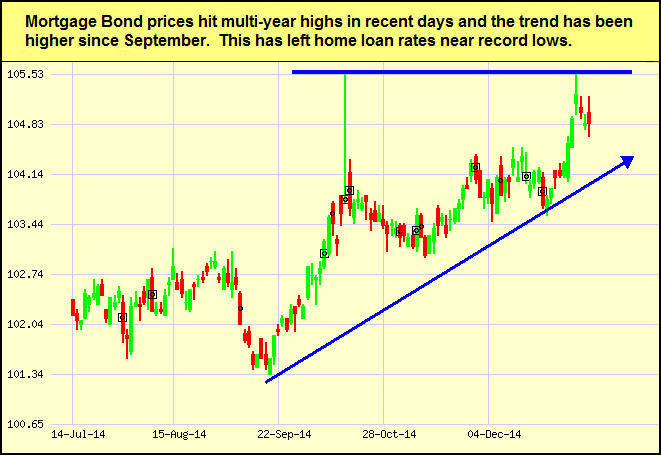
Weak economic news normally causes money to flow out of Stocks and into Bonds, helping Bonds and home loan rates improve, while strong economic news normally has the opposite result. The chart below shows Mortgage Backed Securities (MBS), which are the type of Bond on which home loan rates are based.

When you see these Bond prices moving higher, it means home loan rates are improving—and when they are moving lower, home loan rates are getting worse.

To go one step further—a red "candle" means that MBS worsened during the day, while a green "candle" means MBS improved during the day. Depending on how dramatic the changes were on any given day, this can cause rate changes throughout the day, as well as on the rate sheets we start with each morning.

As you can see in the chart below, Mortgage Bonds have been trending higher. Home loan rates remain near record lows


Chart: Fannie Mae 3.5% Mortgage Bond (Friday January 9, 2015)


Japanese Candlestick Chart
When interest rates drop, here's how to take advantage of them: First, figure out what the best rates are in your area. The gap between the lowest and the highest rate a mortgage applicant is offered averages about 0.30 percentage points, according to mortgage lenders. On a $400,000, 30-year fixed-interest rate loan at 4.03 percent, borrowers will pay $145,000 in interest over the first 10 years of the loan and $289,969 in interest over the life of the loan. Calculating: With a 3.73 percent interest rate, borrowers will pay $11,464 less in the first 10 years and $24,717 less over 30 years. Following the $400,000 example, a person with a FICO score higher than 740 on a scale that ranges from 300 to 850, who is paying 20 percent down, could get a mortgage at 3.75 percent interest from an online lender or 4.07 percent from local lenders. Some banks charge less if you have a savings account or brokerage account with them. Once you find a rate that appeals to you, figure out how much you'll pay per month and whether that amount is manageable.

For more mortgage info, please contact me. I work with different in-house lenders who can help you become (pre) approved and ready to move.  858-603-7879 OR  robert@sandiego-ca-homes.com

 
www.rmsandiegohomes.listingbook.com / www.sandiego-ca-homes.com


BR/
Robert Moore


Labels: , , , , , , , , , , , ,

Wednesday, November 26, 2014

San Diego Sees Conforming Loan Limit Increase to $562,350 in 2015


Fannie Mae and Freddie Mac were created by Congress. They perform an important role in the nation’s housing finance system – to provide liquidity, stability and affordability to the mortgage market. They provide liquidity (ready access to funds on reasonable terms) to the thousands of banks, savings and loans, and mortgage companies that make loans to finance housing.

Fannie Mae and Freddie Mac buy mortgages from lenders and either hold these mortgages in their portfolios or package the loans into mortgage-backed securities (MBS) that may be sold. Lenders use the cash raised by selling mortgages to the Enterprises to engage in further lending. The Enterprises’ purchases help ensure that individuals and families that buy homes and investors that purchase apartment buildings and other multifamily dwellings have a continuous, stable supply of mortgage money.


Fannie Mae and Freddie Mac are restricted by law to purchasing single-family mortgages with origination balances below a specific amount, known as the “conforming loan limit.” Loans above this limit are known as jumbo loans. The national conforming loan limit for mortgages that finance single-family one-unit properties increased from $33,000 in the early 1970s to $417,000 for 2006-2008, with limits 50 percent higher for four statutorily-designated high cost areas: Alaska,  Hawaii, Guam, and the U.S. Virgin Islands.

Since 2008, various legislative acts increased the loan limits in certain high-cost areas in the United States.  While some of the legislative initiatives established temporary limits for loans originated in select time periods, a permanent formula was established under the Housing and Economic Recovery Act of 2008 (HERA).  The 2015 loan limits have been set under the HERA formula.


In line with Federal Housing Finance Agency (FHFA)  November 24, 2014 announcement on the 2015 loan limits, the base conforming loan limits at the existing 2014 levels through December 31, 2015 are being maintained, and increasing the high-cost areas loan limits in certain counties.


Single-Family Update


Loan Limit Increase for 46 High-cost Areas And What This Means for San Diego

FHFA has identified 46 counties in designated high-cost areas where the high-cost area loan limits will increase. All other high-cost area loan limits will remain unchanged from the 2014 levels. San Diego is one of four California counties identified as high-cost areas.

This is fantastic news for borrowers of conforming loans. The current threshold is $546,250 in San Diego County, which is set to increase to $562,350 in 2015, that's an increase of $16,100. Qualifying buyers will have an additional $16,100 at their disposal for a home purchase in 2015. With interest rates still at historical lows, this will serve buyers well, especially those first-time home buyers looking to enter the home equity market.

For more information on becoming pre-approved for a mortgage loan that matches your requirements, feel free to give me a call at 858-603-7879 or email me at robert@sandiego-ca-homes.com www.sandiego-ca-homes.com


BR/
RM


Labels: , , , , , , , , , , , , , , ,