Thursday, July 30, 2015

5 Questions for The First-Time Home Buyer


Usually, a first-time homebuyer picks out a house before lining up financing, but it should actually be the opposite. Buyers often call a Realtor first and then the Realtor refers them to a mortgage person. Realtors are there to guide first-time homebuyers through the entire process. This can start by providing names of reputable lenders with a proven track record that you can individually interview to find out which mortgage lender and which loan product is going to be the right one for you.

Before you actually set your sights on viewing properties, sit down have a long hard look at the pros and cons of homeownership as well as your current financial situation. Establish what you feel you could afford based on your budget.

Ask yourself these five questions then contact a Realtor and / or Lender:

1) How much can I afford?

It may be hard to figure out how much you can truly afford. The very best ratio to have is one-fourth of your income going toward house payments. This means net income, or 25 percent of what you earn after taxes -- lenders calculate using gross income. "Anywhere between 25 (percent) and 32 (percent) is safe. Anything over 35 (percent) is the danger zone.
A higher ratio puts you at risk if anything changes. Insurance or tax rates can increase, putting you over your monthly budget. Then there is the prospect of job loss. With 25 percent, even with the loss of one income, you can still keep your home,
You should essentially know your financial situation before you approach a lender and borrow accordingly. A 30-year fixed mortgage is preferable. Chart out how high your payments would be at different rates by using a mortgage calculator. You'll find one at:  www.sandiego-ca-homes.com. Once you've determined your monthly principal and interest, factor in taxes, insurance and any HOA/Condo fees and special assessments that may apply such as Mello-Roos, as well as utilities.
Once you know what you can afford to pay on the mortgage, you can figure out your housing price range.

2) What are my costs outside of the loan?

First-timers tend to miscalculate the total tab for sealing the purchase and the cost of maintaining a home.Have a thorough conversation about down payment costs and closing costs, You need to know the total out-of-pocket costs. Next, make sure you consider all the monthly charges.
If you're buying a fixer-upper, get several contractor bids so you know what lies ahead.
You always have to be prepared, new or old, to make any repairs, If your mortgage is at 25 percent of income, repairs can bring your cost to 30 percent. We always say you should have three months of basic living expenses in a very liquid place, and part of that is your house emergency fund," Cecere says. Finally, double-check utilities and tax costs to avoid nasty surprises.


3) What do I need in a neighborhood?

I always sit down and say, 'Give me your wish list,' What are the must-haves?"
Your particular lifestyle is key. What do you do when you come home?" That can help you determine whether proximity to a gym, park or good restaurants matters.
I urge buyers to consider how they will get from home to other places. Walking three blocks to a bus stop when it's 90 degrees can be less refreshing in the blistering heat. If you drive, try out the route before you buy. Check out potential neighborhoods at different times of day,
Sure, look at the MLS, see the reports, but walk the neighborhood.

4) Will this house fit my long-term goals?

While you have to make a purchasing decision based on your current financial situation, you should imagine your future personal and work life. Are you going to grow your family? and How many bedrooms do you need? If you think an elderly parent may move in or you'll need a home office, include that in your decision. Don't forget about schools. Sometimes, paying more for a house can be cheaper in the long run. A pricier home in a better school district can be cheaper than a lower-priced home plus private school for 13 years. This home will let us go for public school and not pay $50,000 for private school, may be the better course of thought.

5) Am I prepared to be a homeowner?

Whatever your money attitude is, when you have a home, a lot of your money will go (to it), A lot of your time will be spent dealing with your home. Make sure you understand what's involved. You should ask yourself before buying if you have good spending habits.
If you're ready and buy responsibly,  homebuying can absolutely be a wise financial move. Owning a house is still better than renting, and you should absolutely be able to find a great house for what you can afford.


Call me if you would like to get started. You can reach me at 858-603-7879 or email me at robert@sangiego-ca-homes.com


Labels: , , , , , , , , , , , , ,

Saturday, June 27, 2015

Still undecided as to whether you should purchase, when to purchase, or why you should purchase a home? Here are four reasons you should consider buying a home NOW!

 It's really time to get off that fence and take Action!

Yesterday - Today - Tomorrow

Four reasons you should consider buying a home now:
1. Interest rates are not going down anytime soon.  
Interest rates are currently hovering slightly below 4% for a 30-year fixed-rate mortgage. However, Zillow is expecting interest rates to rise to 5% by the end of the year, which is a huge difference from the nearly 4% interest rate we are currently experiencing.
Interest rates are not expected to stay at historic lows anytime in the near future, so buying a home sooner rather than later may mean that you may be able to save a few thousand dollars each year, depending on the amount of the mortgage you plan on taking out.
According to the most recent Freddie Mac Primary Mortgage Rate Survey, the 30-year fixed-rate mortgage averaged 4.02% with an average 0.7 point for the week ending June 25, 2015, up from last week when it averaged 4.00%. A year ago at this time, the 30-year FRM averaged 4.14%.

When interest rates push up, the size of the home you can afford is pushed down. Anyone who purchases a home and requires a mortgage loan to do so has a monthly budget, a maximum housing allowance, to go by. If more of your budget is going toward paying interest, that will mean that your actual home purchase price maximum will need to be less than originally planned, pushing you either into a smaller home or into an area with lower prices.

2. There are cheaper mortgage insurance premiums in effect.
Due to there being cheaper mortgage insurance premiums, in some cases it may be a better idea to buy a home sooner due to all of the other benefits of buying now, instead of waiting later when housing may be more expensive and interest rates may be higher. Yes, saving for a larger down payment may be a great idea, but when you combine all of the factors in this article, you may actually find yourself losing money over the long-term.
Back in January, The Obama Administration directed, via executive action, the Federal Housing Administration to reduce annual mortgage insurance premiums by 50 basis points, from 1.35% to 0.85%.

3. We are in an appreciating market, and home values are expected to increase.
Home prices are said to be increasing and they are only expected to keep increasing in the future. Inventory in San Diego is down and extremely low and is expected to shrink further, homes are being sold above asking price, and interest rates are climbing. Also, according to Freddie Mac, home prices are expected to see a price gain of 4.5% in 2015 alone, and they’re expected to keep increasing in the following years.
The latest house price index from the Federal Housing Finance Agency said home prices slightly increased in April, inching up 0.3% from March.

4. Rent prices are increasing.
Rent prices are increasing month after month in the United States and San Diego is no exception. You may even find yourself paying a higher amount towards rent each month than you would if you had a monthly mortgage payment.
According to Zillow’s most recent real estate market report, rents for residential housing in the United States grew at their fastest pace in two years in April, surpassing home values. Rents outpaced home values in 20 of the 35 largest U.S. housing markets.

Labels: , , , , , , , , , , ,

Sunday, June 7, 2015

Zillow, Trulia? Listingbook! Another Great Alternative to Search for Homes in San Diego

This a really an easy way to snoop around and see what's available on the market - whether you're six months out from purchasing a home or just six weeks away from needing to get settled in to the right place. Listingbook is a fantastic home search tool. Listingbook is a program that I sponsor and subscribe to so that potential buyers (and sellers) who express wanting to view properties online have a means to do so. Unlike some of the other big-name property listing programs you'll find online, the listing information contained in Listingbook is accurate and up to date. 

Listingbook interfaces directly with the local Multiple Listing Service (MLS) and provides you with morning reports that offer information on new listings and status changes such as price reductions or whether a property you've had your eye has gone under contract, has been sold or has come back on the market.

If you're not satisfied with other online tools such as Trulia or Zillow, turn to Listingbook. You'll be able navigate through MLS listings as an agent would, implement your own criteria and track homes of interest.

To get started, send me an email at robert@sandiego-ca-homes.com with some basic information or simply go straight to www.rmsandiegohomes.listingbook.com and follow the activation steps. From there, you are on your own and can search for properties independently. Have a question, you can always send and email, call or text. This is a no-obgligation, no-cost service to you.

Feel free to peruse the brochure below to learn more. Just one click on the image to enlarge.  -Robert


Labels: , , , , , , , , , , , , , ,

Tuesday, April 14, 2015

National Geographic Channel Selects San Diego As One of World's Smart Cities- April 25 and May 2 @ 8am

Tune in Saturday morning on April 25 or May 2 @ 8am to see how San Diego is presented to be one of National Geographic Channel's chosen cities for the filming of the documentary series "World Smart Cities." This unprecedented exploration of the world's cities seeks to showcase destinations where technology, talent and innovation are creating new urban environments that will emerge as leading cities in the 21st century.
Thanks to a strong technology sector, local innovators, green practices, smart public planning and an unparalleled quality of life, San Diego is the only U.S. city to be featured in this documentary series that will air in 20+ countries in 2015.
National Geographic's
National Geographic's "World Smart Cities" crew captures the spirit of San Diego.
From now through Oct. 23, National Geographic Channel is filming San Diego's best and brightest, including:
  • Environmental innovation at San Diego Gas & Electric's Smart Grid.
  • The Port of San Diego and how it has become a leader in environmental issues with its new shore-power system at the Tenth Avenue Marine Terminal.
  • The environmental protection efforts of SeaWorld San Diego, which has rescued and helped over 22,000 marine animals, along with SeaWorld's ground-breaking research studies in marine animal science.
  • How San Diego attracts innovation and talent, highlighting the work being done by J. Craig Venter with human genome sequencing.
  • UC San Diego's San Diego Center for Algae Biotechnology, which engineers algae for the production of hydrocarbon molecules that can be used as biofuels.
  • The innovation in yeast cultivation done by San Diego-based White Labs, highlighting San Diego's dynamic craft beer scene.
  • Illumina, recognized as "One of the 50 Smartest Businesses in the World."
  • Northrop Gumman's work with Unmanned Aerial Vehicles for NASA which are involved with climate change measurements.
  • The New San Diego Central Library, its stunning architecture and dynamic public art.
  • San Diego's active lifestyle and action sports culture. Surf legend Rob Machado will share the work of his foundation, which helps provide clean drinking water and engages disadvantaged youth in healthy lifestyle activities.
  • San Diego's spirit, as defined by our cultural roots, from ethnography to gastronomy.
Host Andrew Evans learns about San Diego's culture and cuisine from chef Su-Mei Yu.
Broadcast will begin in spring 2015 in approximately 25 different countries, including the United States, Austria, the United Kingdom, Switzerland, Japan, France, Korea, Italy, Australia, Russia, New Zealand, Spain, China, Brazil and more.
The 50-minute San Diego episode is expected to reach more than 150 million international households and approximately 85 million U.S. households, providing record exposure for the city as a leading business and travel destination.

FUNDING PARTNERS

The following organizations have provided funding for the filming of National Geographic Channel's "World's Smart Cities: San Diego":
  • City of San Diego
  • County of San Diego
  • San Diego Tourism Authority
  • San Diego Tourism Marketing District
  • San Diego Regional Economic Development Corporation
  • Port of San Diego
  • San Diego County Regional Airport Authority
  • SeaWorld San Diego
  • Sempra Energy
  • University of California, San Diego
  • Legler Benbough Foundation
  • Malin Burnham
  • The San Diego Foundation
  • Qualcomm

Labels: , , , , , , , , , , , ,

Tuesday, March 31, 2015

All The Benefits of UTC Condo Living!

Condominiums, townhomes, and even single-family homes are most often located in what is called a Common Interest Development (CID). A CID is a development involving a combination of individually owned lots or units, along with common area spaces or parcels shared with other owners in the same development.
Why buy a Condo in San Diego?

Advantages
  • Common Interest Developments offer a home ownership interest in attractive properties in convenient locations, coupled with desirable amenities often not available to most owners residences outside of a CID.
  • Enjoy the feeling of “Home-Sweet-Home” and build wealth and equity for the future with a condo or townhome purchase.
  • Escape from renting and “throwing your money down the drain.”
  • Condos offer affordable home ownership
  • Condo ownership increases equity
  • Enjoy amenities CIDs often have to offer
  • Shared vision of “quality living” with neighbors
  • Freedom from building and common area maintenance
  • Increased security
  • Built-in social networking/activities
  • Ease of “move-up” or “move down” mobility
  • Management choices
  • Shared decision-making
  • Shared expenses
  • Home ownership tax advantages (deductible mortgage interest and property taxes, as well as capital gain tax treatment and exclusions
  • Proximity to conveniences
  • Excellent sales appeal in an “up economy”
Architectural Styles
1. High rise (min. of 10 stories)
2. Mid rise (4-10 stories)
3. Low rise (up to 3 stories)
4. Townhouse (condo consisting of 2 or more stories; no other units above or below)
5. Garden style (low-rise with predominant, lush landscaping
6. Free standing (single-family style)
7. Duplex (two-family structure with one side mirroring the other, shares common wall and roof.

utc condos utc townhomes
The Davis-Stirling Act
The Davis-Stirling Common Interest Development Act is the popular name of the portion of the California Civil Code beginning with section 4000, which governs condominium, cooperative, and planned unit development communities in California. It was authored by Assemblyman Lawrence W. Stirling and enacted in 1985 by the California State Legislature. In 2012, the Act was comprehensively reorganized and recodified by Assembly Bill 805. As of January 1, 2014, Title 6 (commencing with Section 4000 of Part 4 of Division 2 of the Civil Code) is repealed, effectively replaced by newly added Part 5 (commencing with Section 4000) to Division 4 of the Civil Code.

Under Davis-Stirling, a developer of a common interest development is able to create a homeowner association (HOA) to govern the development. As part of creating the HOA, the developer records a document known as the Declaration of Covenants, Conditions, and Restrictions (CC&Rs) against the units or parcels within the HOA with the county recorder.

Homeowners Association (HOA)
Although The California Davis-Stirling Act does not specifically provide a definition for a Homeowners Association or HOA, an HOA is generally understood to mean: a legal entity created by a real estate developer, or group of property owners, by which a community development is manged, its commonly owned improvements and amenities are maintained, and its rules and regulations are enforced, through a Board of Directors or other governing board.

Governing Documents
Governing documents define the rights and responsibilities of the association and its owners. They set policies and create a contractual relationship between the owners and the association. These documents may include any of the following:
  • Declaration of Covenants, Conditions & Restrictions (CC&Rs)
  • A condominium plat, map or plan
  • Articles of Incorporation / Association
  • Bylaws
  • Operating Rules – Rules Regulations
  • Other documents that govern the operation of the common interest development or association.

Labels: , , , , , , , , , , , , ,

Friday, February 6, 2015

San Diego Home Affordability Still Riding The Wave


Over the last three years, sellers were more than pleased to see that homes were selling for a total of 25 percent more than three years before, according to the S&P/Case Shiller Index. Sellers were pleased; buyers not so much.

So far in 2015, slower gains for San Diego sellers have helped to make home affordability a more positive factor.

Sellers are still going to net more from a home sale than they would have in recent years.

But these same sellers, those who recently decided to trade up or move to a smaller place, are still doing buyers a big favor.

It's a lovely circle.  San Diego prices have been going up, which makes some sell, and that puts more choice homes on the market, which makes others want to buy. Even with the extremely tight resale inventory in San Diego, slight increases of great homes, combined with higher price levels result in prices becoming more settled and more of a balance plays out.

Real estate agents may be more likely to make recommendations that meet all the buyer's wants, instead of just a few.

Experts say it is too soon to calculate San Diego County affordability for this year, but if you buy a home in San Diego today it will definitely be more affordable than a year from now.

Quoted in The Wall Street Journal, Bill McBride, who writes the popular Calculated Risk blog, reminds us that in the existing housing market, active inventory may influence pricing somewhat, but it also influences sales. 

McBride says that in 2014, home sales were just so-so, mainly because inventories remained low. 

Mortgage interest rates for 30-year instruments have drifted back to about 4 percent or less in some areas. Some economists, however, say rates will rise beginning in June or July of this year.

According to Greater San Diego Association of REALTORS®, median sales price of existing homes rose 9 percent in 2014, with sales picking up at the end of the year. The prices of previously owned homes sold in San Diego County rose by 9 percent during 2014 , according to new housing statistics from the Greater San Diego Association of REALTORS® (SDAR).

While not as dramatic as the 20-percent rise in prices the previous year, the increase is a healthy sign for the local housing market. The 2014 median price of single-family homes increased to $495,000, while the price of condos and townhomes reached $325,000.Though the single-family home price in September and October was actually higher, weighing in at $510,000 and $500,000 respectively.
Sales increased in December compared to November. Single-family home sales jumped 11 percent, and condos/townhome sales were up 5 percent. For the year, however, total sales were 12 percent lower than 2013.
Active listings on the Multiple Listing Service (MLS) in San Diego County have been on the decline, and are now less than 6,000, about the same as one year ago, representing about 2.5 months of housing stock. (Five to six months is considered a healthy inventory level.) On average in 2014, homes were selling within 45 days of their list date.

As homeowners recapture more of their previously lost equity with home values rising to healthy levels, San Diegans will see more homes on the market this year, which will allow for the natural shifts to take place in the housing market. The projected increase in interest rates should boost inventory levels and drive sales.

We live in a wonderful coastal area with an outstanding climate. San Diego truly is one of the most beautiful places on earth. People want to live here and those who do are very fortunate.

In December, the zip codes in San Diego County with the most single-family sales were:

• 92157 (Oceanside) with 49
• 92114 (Encanto) with 43
• 92127 (Rancho Bernardo) with 42
• 92028 (Fallbrook) with 42
• 92009 (Carlsbad) with 40

The most expensive listing sold in the county last month was a 3-bedroom 3-bath, 2,500-square-foot beach home in Solana Beach that sold for $8.75 million.


Labels: , , , , , , , , , , ,

Monday, January 12, 2015

Should We Get A Mortgage Now Or Wait for Interest Rates to Fall?


Interest rates on the 30-year fixed-rate mortgage change all the time, so today's rate probably isn't the same as last month's or next month's - in fact, it isn't.

If you've found the home you want, you might as well take the plunge. On January 3, 2014, the average interest rate for a 30-year fixed-rate mortgage was 4.63 percent nationwide. By October 17, the rate fell to 4.03 percent and remained there for a week or more. It was the lowest level since June 2013 according to the mortgage-information website HSH.com.  Demand for home loans surged, but the increase was driven by homeowners seeking to refinance existing mortgages.  Today’s purchase rates are even lower.

Here's what's behind the lower home loan rates:
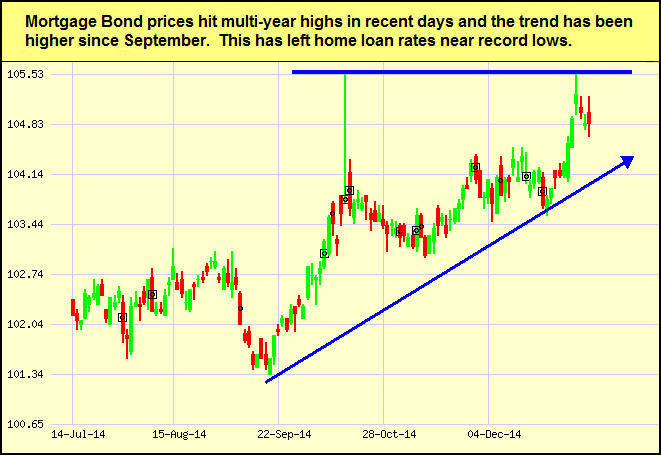
Weak economic news normally causes money to flow out of Stocks and into Bonds, helping Bonds and home loan rates improve, while strong economic news normally has the opposite result. The chart below shows Mortgage Backed Securities (MBS), which are the type of Bond on which home loan rates are based.

When you see these Bond prices moving higher, it means home loan rates are improving—and when they are moving lower, home loan rates are getting worse.

To go one step further—a red "candle" means that MBS worsened during the day, while a green "candle" means MBS improved during the day. Depending on how dramatic the changes were on any given day, this can cause rate changes throughout the day, as well as on the rate sheets we start with each morning.

As you can see in the chart below, Mortgage Bonds have been trending higher. Home loan rates remain near record lows


Chart: Fannie Mae 3.5% Mortgage Bond (Friday January 9, 2015)


Japanese Candlestick Chart
When interest rates drop, here's how to take advantage of them: First, figure out what the best rates are in your area. The gap between the lowest and the highest rate a mortgage applicant is offered averages about 0.30 percentage points, according to mortgage lenders. On a $400,000, 30-year fixed-interest rate loan at 4.03 percent, borrowers will pay $145,000 in interest over the first 10 years of the loan and $289,969 in interest over the life of the loan. Calculating: With a 3.73 percent interest rate, borrowers will pay $11,464 less in the first 10 years and $24,717 less over 30 years. Following the $400,000 example, a person with a FICO score higher than 740 on a scale that ranges from 300 to 850, who is paying 20 percent down, could get a mortgage at 3.75 percent interest from an online lender or 4.07 percent from local lenders. Some banks charge less if you have a savings account or brokerage account with them. Once you find a rate that appeals to you, figure out how much you'll pay per month and whether that amount is manageable.

For more mortgage info, please contact me. I work with different in-house lenders who can help you become (pre) approved and ready to move.  858-603-7879 OR  robert@sandiego-ca-homes.com

 
www.rmsandiegohomes.listingbook.com / www.sandiego-ca-homes.com


BR/
Robert Moore


Labels: , , , , , , , , , , , ,

Friday, November 28, 2014

Buyers Beware: Ensure That Your Agents Are Using The Newly Revised Residential Purchase Agreement


Buyers, this may come as a surprise to some agents: The CALIFORNIA ASSOCIATION OF REALTORS® Residential Purchase Agreement (RPA) has been revised as of November 2014. The 2014 RPA is 10 pages long and contains 32 paragraphs and approx. 150 lettered paragraphs, some of which have been relocated within the RPA. The revisions encompass newly written/introduced or modified language in the Agreement. Please check with your agents to ensure that they are using the correct version of the Residential Purchase Agreement and attendant forms when submitting your offer. For more information on this subject, please feel free to call me at 858-603-7879 or email me at robert@sandiego-ca-homes.com

                                              BR/RM


Labels: , , , , , , , , , , , ,

Wednesday, November 26, 2014

San Diego Sees Conforming Loan Limit Increase to $562,350 in 2015


Fannie Mae and Freddie Mac were created by Congress. They perform an important role in the nation’s housing finance system – to provide liquidity, stability and affordability to the mortgage market. They provide liquidity (ready access to funds on reasonable terms) to the thousands of banks, savings and loans, and mortgage companies that make loans to finance housing.

Fannie Mae and Freddie Mac buy mortgages from lenders and either hold these mortgages in their portfolios or package the loans into mortgage-backed securities (MBS) that may be sold. Lenders use the cash raised by selling mortgages to the Enterprises to engage in further lending. The Enterprises’ purchases help ensure that individuals and families that buy homes and investors that purchase apartment buildings and other multifamily dwellings have a continuous, stable supply of mortgage money.


Fannie Mae and Freddie Mac are restricted by law to purchasing single-family mortgages with origination balances below a specific amount, known as the “conforming loan limit.” Loans above this limit are known as jumbo loans. The national conforming loan limit for mortgages that finance single-family one-unit properties increased from $33,000 in the early 1970s to $417,000 for 2006-2008, with limits 50 percent higher for four statutorily-designated high cost areas: Alaska,  Hawaii, Guam, and the U.S. Virgin Islands.

Since 2008, various legislative acts increased the loan limits in certain high-cost areas in the United States.  While some of the legislative initiatives established temporary limits for loans originated in select time periods, a permanent formula was established under the Housing and Economic Recovery Act of 2008 (HERA).  The 2015 loan limits have been set under the HERA formula.


In line with Federal Housing Finance Agency (FHFA)  November 24, 2014 announcement on the 2015 loan limits, the base conforming loan limits at the existing 2014 levels through December 31, 2015 are being maintained, and increasing the high-cost areas loan limits in certain counties.


Single-Family Update


Loan Limit Increase for 46 High-cost Areas And What This Means for San Diego

FHFA has identified 46 counties in designated high-cost areas where the high-cost area loan limits will increase. All other high-cost area loan limits will remain unchanged from the 2014 levels. San Diego is one of four California counties identified as high-cost areas.

This is fantastic news for borrowers of conforming loans. The current threshold is $546,250 in San Diego County, which is set to increase to $562,350 in 2015, that's an increase of $16,100. Qualifying buyers will have an additional $16,100 at their disposal for a home purchase in 2015. With interest rates still at historical lows, this will serve buyers well, especially those first-time home buyers looking to enter the home equity market.

For more information on becoming pre-approved for a mortgage loan that matches your requirements, feel free to give me a call at 858-603-7879 or email me at robert@sandiego-ca-homes.com www.sandiego-ca-homes.com


BR/
RM


Labels: , , , , , , , , , , , , , , ,