Saturday, June 27, 2015

Still undecided as to whether you should purchase, when to purchase, or why you should purchase a home? Here are four reasons you should consider buying a home NOW!

 It's really time to get off that fence and take Action!

Yesterday - Today - Tomorrow

Four reasons you should consider buying a home now:
1. Interest rates are not going down anytime soon.  
Interest rates are currently hovering slightly below 4% for a 30-year fixed-rate mortgage. However, Zillow is expecting interest rates to rise to 5% by the end of the year, which is a huge difference from the nearly 4% interest rate we are currently experiencing.
Interest rates are not expected to stay at historic lows anytime in the near future, so buying a home sooner rather than later may mean that you may be able to save a few thousand dollars each year, depending on the amount of the mortgage you plan on taking out.
According to the most recent Freddie Mac Primary Mortgage Rate Survey, the 30-year fixed-rate mortgage averaged 4.02% with an average 0.7 point for the week ending June 25, 2015, up from last week when it averaged 4.00%. A year ago at this time, the 30-year FRM averaged 4.14%.

When interest rates push up, the size of the home you can afford is pushed down. Anyone who purchases a home and requires a mortgage loan to do so has a monthly budget, a maximum housing allowance, to go by. If more of your budget is going toward paying interest, that will mean that your actual home purchase price maximum will need to be less than originally planned, pushing you either into a smaller home or into an area with lower prices.

2. There are cheaper mortgage insurance premiums in effect.
Due to there being cheaper mortgage insurance premiums, in some cases it may be a better idea to buy a home sooner due to all of the other benefits of buying now, instead of waiting later when housing may be more expensive and interest rates may be higher. Yes, saving for a larger down payment may be a great idea, but when you combine all of the factors in this article, you may actually find yourself losing money over the long-term.
Back in January, The Obama Administration directed, via executive action, the Federal Housing Administration to reduce annual mortgage insurance premiums by 50 basis points, from 1.35% to 0.85%.

3. We are in an appreciating market, and home values are expected to increase.
Home prices are said to be increasing and they are only expected to keep increasing in the future. Inventory in San Diego is down and extremely low and is expected to shrink further, homes are being sold above asking price, and interest rates are climbing. Also, according to Freddie Mac, home prices are expected to see a price gain of 4.5% in 2015 alone, and they’re expected to keep increasing in the following years.
The latest house price index from the Federal Housing Finance Agency said home prices slightly increased in April, inching up 0.3% from March.

4. Rent prices are increasing.
Rent prices are increasing month after month in the United States and San Diego is no exception. You may even find yourself paying a higher amount towards rent each month than you would if you had a monthly mortgage payment.
According to Zillow’s most recent real estate market report, rents for residential housing in the United States grew at their fastest pace in two years in April, surpassing home values. Rents outpaced home values in 20 of the 35 largest U.S. housing markets.

Labels: , , , , , , , , , , ,

Monday, January 12, 2015

Should We Get A Mortgage Now Or Wait for Interest Rates to Fall?


Interest rates on the 30-year fixed-rate mortgage change all the time, so today's rate probably isn't the same as last month's or next month's - in fact, it isn't.

If you've found the home you want, you might as well take the plunge. On January 3, 2014, the average interest rate for a 30-year fixed-rate mortgage was 4.63 percent nationwide. By October 17, the rate fell to 4.03 percent and remained there for a week or more. It was the lowest level since June 2013 according to the mortgage-information website HSH.com.  Demand for home loans surged, but the increase was driven by homeowners seeking to refinance existing mortgages.  Today’s purchase rates are even lower.

Here's what's behind the lower home loan rates:
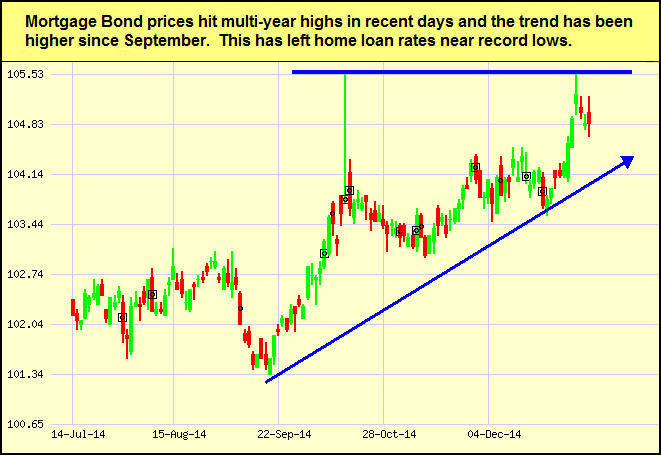
Weak economic news normally causes money to flow out of Stocks and into Bonds, helping Bonds and home loan rates improve, while strong economic news normally has the opposite result. The chart below shows Mortgage Backed Securities (MBS), which are the type of Bond on which home loan rates are based.

When you see these Bond prices moving higher, it means home loan rates are improving—and when they are moving lower, home loan rates are getting worse.

To go one step further—a red "candle" means that MBS worsened during the day, while a green "candle" means MBS improved during the day. Depending on how dramatic the changes were on any given day, this can cause rate changes throughout the day, as well as on the rate sheets we start with each morning.

As you can see in the chart below, Mortgage Bonds have been trending higher. Home loan rates remain near record lows


Chart: Fannie Mae 3.5% Mortgage Bond (Friday January 9, 2015)


Japanese Candlestick Chart
When interest rates drop, here's how to take advantage of them: First, figure out what the best rates are in your area. The gap between the lowest and the highest rate a mortgage applicant is offered averages about 0.30 percentage points, according to mortgage lenders. On a $400,000, 30-year fixed-interest rate loan at 4.03 percent, borrowers will pay $145,000 in interest over the first 10 years of the loan and $289,969 in interest over the life of the loan. Calculating: With a 3.73 percent interest rate, borrowers will pay $11,464 less in the first 10 years and $24,717 less over 30 years. Following the $400,000 example, a person with a FICO score higher than 740 on a scale that ranges from 300 to 850, who is paying 20 percent down, could get a mortgage at 3.75 percent interest from an online lender or 4.07 percent from local lenders. Some banks charge less if you have a savings account or brokerage account with them. Once you find a rate that appeals to you, figure out how much you'll pay per month and whether that amount is manageable.

For more mortgage info, please contact me. I work with different in-house lenders who can help you become (pre) approved and ready to move.  858-603-7879 OR  robert@sandiego-ca-homes.com

 
www.rmsandiegohomes.listingbook.com / www.sandiego-ca-homes.com


BR/
Robert Moore


Labels: , , , , , , , , , , , ,

Wednesday, November 26, 2014

San Diego Sees Conforming Loan Limit Increase to $562,350 in 2015


Fannie Mae and Freddie Mac were created by Congress. They perform an important role in the nation’s housing finance system – to provide liquidity, stability and affordability to the mortgage market. They provide liquidity (ready access to funds on reasonable terms) to the thousands of banks, savings and loans, and mortgage companies that make loans to finance housing.

Fannie Mae and Freddie Mac buy mortgages from lenders and either hold these mortgages in their portfolios or package the loans into mortgage-backed securities (MBS) that may be sold. Lenders use the cash raised by selling mortgages to the Enterprises to engage in further lending. The Enterprises’ purchases help ensure that individuals and families that buy homes and investors that purchase apartment buildings and other multifamily dwellings have a continuous, stable supply of mortgage money.


Fannie Mae and Freddie Mac are restricted by law to purchasing single-family mortgages with origination balances below a specific amount, known as the “conforming loan limit.” Loans above this limit are known as jumbo loans. The national conforming loan limit for mortgages that finance single-family one-unit properties increased from $33,000 in the early 1970s to $417,000 for 2006-2008, with limits 50 percent higher for four statutorily-designated high cost areas: Alaska,  Hawaii, Guam, and the U.S. Virgin Islands.

Since 2008, various legislative acts increased the loan limits in certain high-cost areas in the United States.  While some of the legislative initiatives established temporary limits for loans originated in select time periods, a permanent formula was established under the Housing and Economic Recovery Act of 2008 (HERA).  The 2015 loan limits have been set under the HERA formula.


In line with Federal Housing Finance Agency (FHFA)  November 24, 2014 announcement on the 2015 loan limits, the base conforming loan limits at the existing 2014 levels through December 31, 2015 are being maintained, and increasing the high-cost areas loan limits in certain counties.


Single-Family Update


Loan Limit Increase for 46 High-cost Areas And What This Means for San Diego

FHFA has identified 46 counties in designated high-cost areas where the high-cost area loan limits will increase. All other high-cost area loan limits will remain unchanged from the 2014 levels. San Diego is one of four California counties identified as high-cost areas.

This is fantastic news for borrowers of conforming loans. The current threshold is $546,250 in San Diego County, which is set to increase to $562,350 in 2015, that's an increase of $16,100. Qualifying buyers will have an additional $16,100 at their disposal for a home purchase in 2015. With interest rates still at historical lows, this will serve buyers well, especially those first-time home buyers looking to enter the home equity market.

For more information on becoming pre-approved for a mortgage loan that matches your requirements, feel free to give me a call at 858-603-7879 or email me at robert@sandiego-ca-homes.com www.sandiego-ca-homes.com


BR/
RM


Labels: , , , , , , , , , , , , , , ,